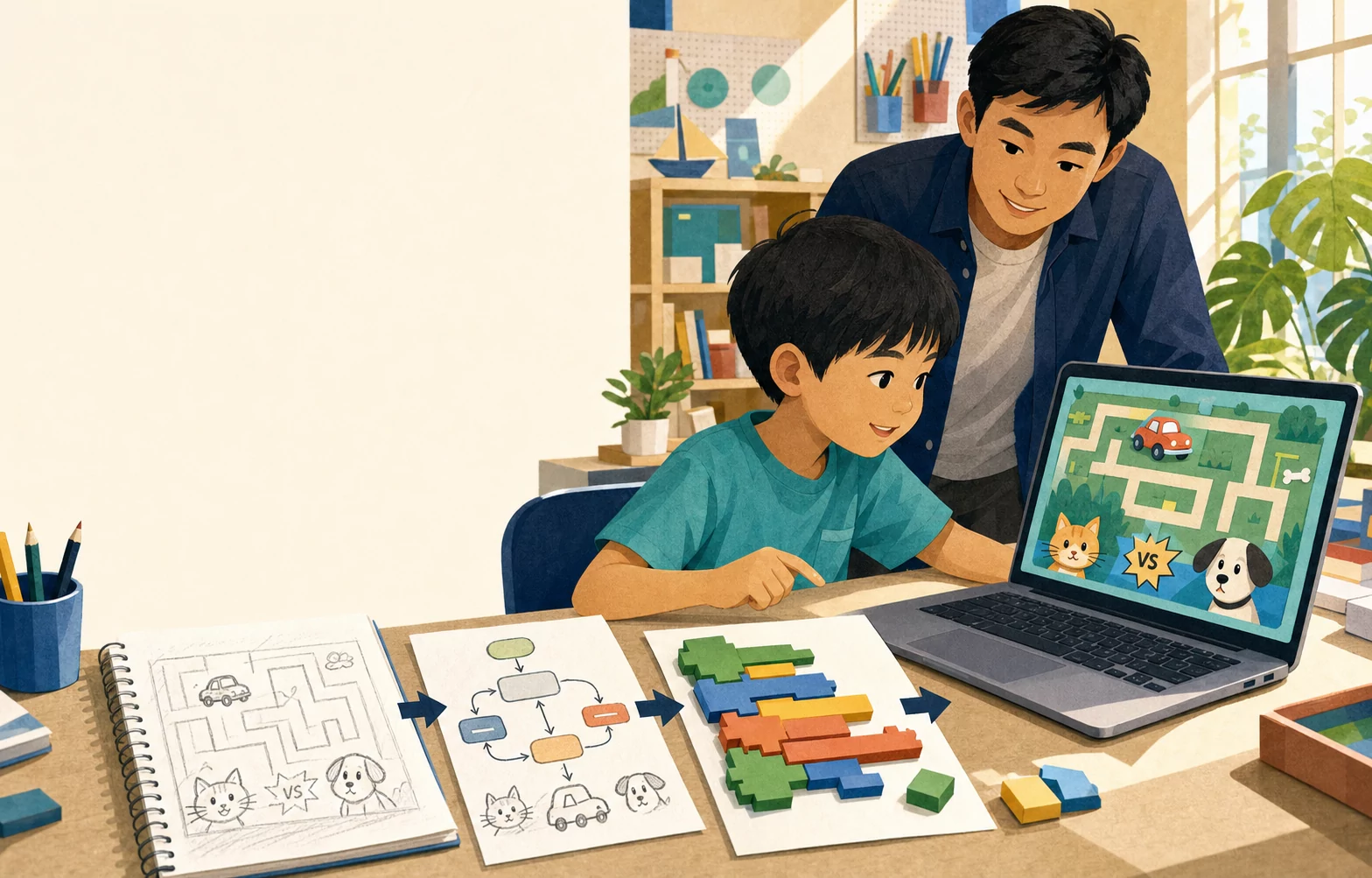
Illustration of a child turning a game sketch and flowchart into a playable maze game with guidance from an instructor
In-person course for ages 6+

Teach your child to think before AI writes

A 12-lesson, in-person course where children plan, design and build their first game or mini app with guided AI.

12guided lessons
90minutes per lesson
6+readiness assessed individually
30minute free trial
Real student work

Games built by our students

Our students planned, built and tested these playable projects with instructor guidance and a responsible AI-assisted workflow.

Car Maze: Learn Python

Car Maze: Learn Python

A bilingual, 58-mission game where players write Python commands to guide a car through puzzle worlds.

Use case
Make sequences, conditions, loops, functions and debugging visible through immediate movement and feedback.
Built with
Python learning tasks inside a React and JavaScript browser app.
Why
To turn abstract code into a concrete problem children can plan, run, inspect and improve.

Siamese Cat vs Dog 1986

Siamese Cat vs Dog 1986

A bilingual retro browser arcade game with a jetpack Siamese cat, enemy waves, scoring, levels and boss battles.

Use case
Show how input, movement, collisions, game state, difficulty, sound and feedback work together in a complete game.
Built with
Plain HTML, CSS and JavaScript with an HTML5 Canvas game engine.
Why
To learn how a creative idea becomes a responsive, bilingual product with real systems and testing.

AI can write code. Your child still needs to think.

The lasting advantage is not memorising syntax. It is learning how to turn a vague idea into a clear system, test it and improve it.

From “I have an idea” to “Here is my plan”

Children practise defining a goal, breaking it into smaller jobs and deciding what must happen first. That planning habit helps far beyond a computer screen.

Make logic visible

Conditions, loops and variables make cause and effect concrete: if this changes, what should happen next?

Use mistakes as information

Debugging teaches children to pause, inspect evidence, change one thing and test again instead of guessing.

Direct AI, do not obey it

Students learn to give context, question an answer and check whether generated code matches their own design.

Twelve lessons from logic to launch

Every lesson adds a tool the child needs for the final project. The sequence can be paced to the learner's readiness.

Think in systems

Define the problem

  1. Goals, inputs, outputs and limits
  2. Algorithms and clear sequences
  3. Decisions with conditions
Build the logic

Write reusable code

  1. Loops and useful repetition
  2. Variables, data and changing state
  3. Functions and reusable behaviours
Architect the idea

Plan before building

  1. Screens, user flow and game rules
  2. Scope, components and task planning
  3. Interface design and clear feedback
Create with AI

Build, test and present

  1. Ask AI with context and constraints
  2. Debug, test and improve the project
  3. Finish and explain a first game or mini app

English lessons by Siamese Cat Dev

The course is taught in English. A child should be able to follow everyday instructions, describe a simple idea and ask for help when stuck. Perfect grammar is not required.

The free trial checks the part that an age label cannot: whether the child can follow the logic, stay with a problem and communicate well enough to benefit from the session.

Start with a free readiness trial

A younger child may be ready; an older child may need a different pace. We use a short real lesson before admission instead of guessing from age alone.

First meeting30 minutes free

Meet the instructor, try a real logic task and assess whether the child is ready for the course. Children younger than seven are welcome to try.

Register interest
Flexible

Single lesson

2,000 THB

One 90-minute in-person session.

Full programme

12-lesson package

24,000 THB

18,000 THB

Save 6,000 THB compared with twelve individual lessons.

A useful practice, not a magic brain shortcut

Planning, working memory, mental flexibility and self-control are part of what researchers call executive function. Coding gives children repeated opportunities to hold a plan in mind, follow rules, resist guessing and revise after feedback.

Read the research note

Controlled studies with young children have reported improvements in some planning, inhibition, computational-thinking or executive-function measures after structured coding activities. The evidence is promising, but it does not mean every child will get the same result, and this course does not promise a cognitive or academic outcome.

Contact Us