
Siamese Cat vs Dog 1986
A bilingual, mobile-friendly retro arcade game built for the browser with original characters, levels, scoring, sound and responsive controls.
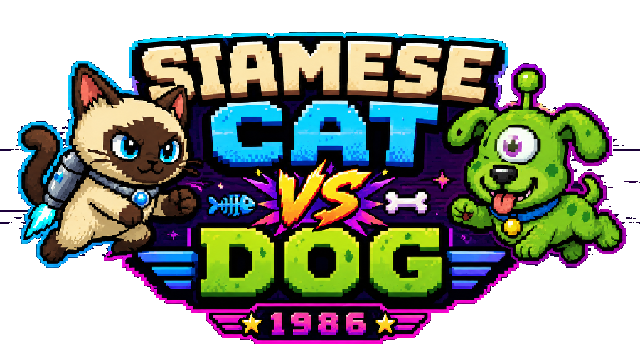
A complete arcade game, not a coding exercise
The player pilots a jetpack Siamese cat through waves of mutant alien dogs. The game combines movement, attacks, collisions, pickups, difficulty modes, stage progression, boss battles, score saving and player feedback.
Its use case is to show students what happens when a small creative idea grows into a product whose systems must remain consistent on phones and computers, in Thai and English.
A lightweight browser game with no gameplay framework
- Programming
- Plain JavaScript manages the game loop, input, movement, collisions, enemies, levels, scoring, audio and saved state.
- Rendering
- HTML5 Canvas draws the responsive portrait game, while CSS provides the surrounding interface and mobile layout.
- Content
- Original pixel art, characters, story, sound effects and music support separate Thai and English editions.
- Browser features
- Touch and pointer input, responsive scaling, localStorage saves, Web Audio, visibility handling and Web Share fallbacks make the game work without an installation.
Complexity was divided into decisions students could test
Instructor guidance kept the project focused on systems and evidence. AI assistance could accelerate a draft, but students still had to understand the rule, connect it safely to the game and test the result during real play.
- Define the player experienceDescribe the controls, challenge, feedback and win or loss conditions before implementation.
- Model the stateTrack the player, enemies, projectiles, score, health, stage and difficulty as explicit data.
- Connect art and rulesMake every sprite, sound and effect communicate something the player needs to know.
- Test on real devicesCheck touch input, resizing, audio, difficulty, bilingual text and long play sessions, then repair the causes of failures.
Because finishing a game teaches more than generating code
The project required creative direction, system architecture, programming, asset integration, bilingual UX and repeated testing. It demonstrates why students need judgment and persistence even when AI can help produce individual pieces.