
Can a Six-Year-Old Learn Coding With AI? Readiness Matters More Than Age
Age six can be a reasonable starting point for coding, but attention, communication and willingness to test ideas matter more than the birthday alone.
Six is a convenient number to print beside a course. It is not a reliable description of how a child approaches a problem.
One six-year-old may enjoy giving precise instructions, noticing a wrong turn and trying again. Another may understand the same idea but become tired after ten minutes at a keyboard. An older child may be confident with games yet resist explaining how a rule works. Age helps narrow the starting point; it does not settle the decision.
Coding readiness appears in ordinary moments
A beginner does not need to know a programming language. More useful signs include being able to:
- follow a short sequence of instructions;
- describe a simple idea in their own words;
- notice when the result differs from the plan;
- stay with a small problem after the first attempt fails;
- ask for help rather than click or guess continuously.
None of these needs to be perfect. They give the instructor somewhere to begin.
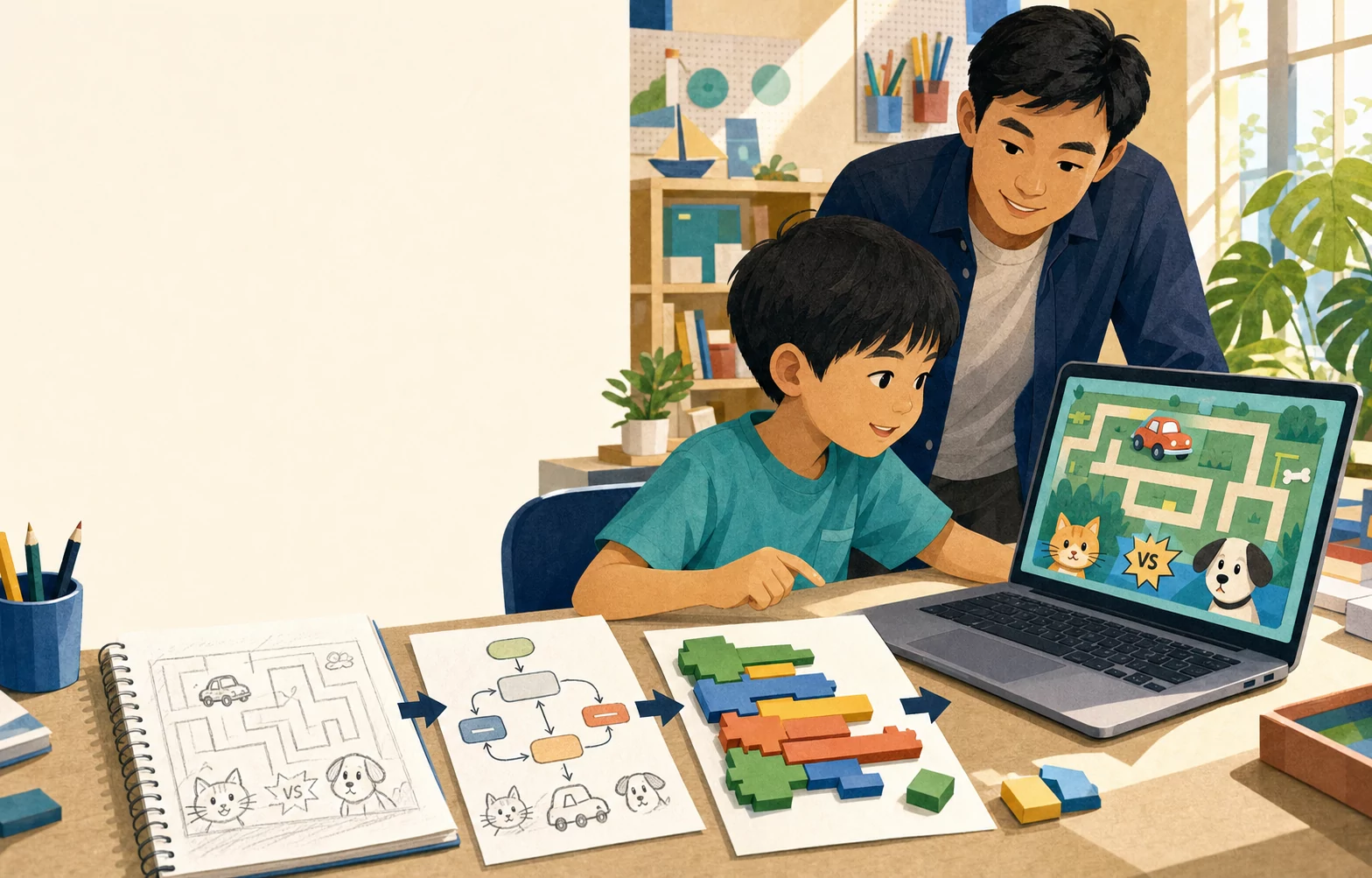
Consider a maze. The child wants a car to reach a goal. They choose “forward, forward, turn right,” then run the instructions. If the car turns into a wall, the learning begins. Can the child look back at the route? Can they change one instruction and run it again? That small loop—plan, test, inspect, revise—is more relevant than whether they can already type quickly.
AI does not remove the need to think
It is easy to imagine an AI coding course as a child asking for a game and receiving one. That may produce code, but it does not produce much understanding.
A useful lesson gives the child responsibility before and after the AI response. What should the game do? What information does the tool need? Which rules must not change? Does the answer solve the intended problem? What broke when the new part was added?
Young learners often need an instructor to reduce those questions to one manageable decision at a time. The goal is not to make the AI look impressive. It is to keep the child connected to the choices inside the project.
Language and lesson length can change the answer
Siamese Cat Creative Club’s Coding with AI course is offered from age six, with readiness assessed individually. Each full lesson is 90 minutes. The English course expects a child to follow everyday English instructions, explain a simple idea and ask for help when stuck; perfect grammar is not required.
Those details matter. A child might understand the logic but need a different teaching language or pace. They might be ready for a short task but not yet for a full session. That is not a failure. It is useful information for choosing what comes next.
Use a real task instead of guessing
The course begins with an optional 30-minute readiness trial. The child meets the instructor and tries a genuine logic activity. The purpose is not to test advanced coding knowledge. It is to see how the child follows the problem, communicates and responds when the first answer needs work.
Parents can watch for a simple signal afterward: does the child want to explain what they tried? Excitement alone does not guarantee course readiness, but the urge to revisit the problem is often more informative than a score.
A six-year-old can learn coding with AI. The honest answer is still “it depends”—not on whether the child appears gifted, but on whether the lesson can meet their current way of thinking and working. A short real trial is the fairest place to decide.